Does Carbon Fiber Always Make PLA-CF Stronger?
Carbon fiber reinforcement increases the rigidity of PLA-based composites, but higher stiffness does not guarantee better performance under every type of mechanical load.
Our Filoostry PLA-CF mechanical test results demonstrate an important difference between XY and Z printing directions. The measured tensile strength reaches 50 ± 1 MPa in the XY direction, compared with 17 ± 1 MPa in the Z direction.
Filoostry PLA-CF Mechanical Performance:
| Test property | XY | Z |
|---|---|---|
| Tensile strength | 50 ± 1 MPa | 17 ± 1 MPa |
| Tensile modulus | 5774 ± 289 MPa | 2363 ± 267 MPa |
| Elongation at break | 1.3 ± 0.1% | 0.9 ± 0.1% |
| Flexural strength | 79 ± 2 MPa | 28 ± 1 MPa |
| Flexural modulus | 6716 ± 163 MPa | 2260 ± 22 MPa |
Test methods: ISO 527 / GB/T 1040 for tensile properties and ISO 178 / GB/T 9341 for flexural properties.
Note: The mechanical test results above are provided for reference only. Actual printed-part performance may vary depending on filament drying conditions, cooling fan speed, printing parameters, printer capabilities, and other processing conditions. Differences in printing environments and specimen preparation can also affect the final results. Please evaluate the material under your specific printing conditions and application requirements.
These results show that printing orientation plays an important role in the mechanical performance of our PLA-CF parts. The XY direction demonstrates higher tensile and flexural properties than the Z direction.
Why do some parts still break easily?
 |
|
Our recommendation: Position load-bearing sections to take advantage of the stronger XY direction where the design permits. Reinforce mounting points, use rounded transitions, and avoid relying on thin sections for concentrated loads.
Why Does PLA-CF Still Clog the Nozzle Even with a Hardened Steel Nozzle?
A hardened steel nozzle reduces abrasive wear from carbon fiber reinforcement, but it does not eliminate extrusion blockages.
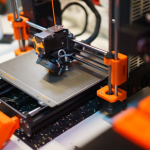
When PLA-CF printing becomes inconsistent, the problem can originate from the nozzle, extruder, filament path, or extrusion conditions.
| What you observe | What to inspect | Recommended action |
|---|---|---|
| Filament stops extruding | Partial nozzle blockage | Clean and inspect the nozzle |
| Extrusion becomes irregular | Extruder drive gears | Remove accumulated filament debris |
| Filament movement becomes restricted | PTFE tube and feeding path | Check bends and feeding resistance |
| Repeated blockage with a small nozzle | Nozzle diameter and material compatibility | Test a compatible 0.6 mm nozzle |
Filoostry PLA-CF supports 0.4 mm, 0.6 mm, and 0.8 mm nozzle options. A 0.6 mm nozzle provides a larger extrusion opening and serves as a practical troubleshooting option when repeated restrictions occur with a smaller nozzle.
A hardened nozzle addresses abrasion, while proper nozzle clearance and a clean feeding system address other extrusion problems.
Will PLA-CF Parts Deform Under Long-Term Loads?
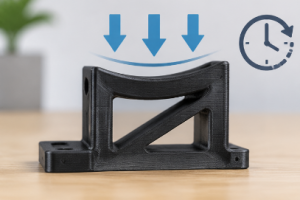 PLA-CF offers high rigidity, but continuous mechanical loading introduces another consideration: creep.
Creep is the gradual deformation of a material under sustained stress. A component can maintain its original dimensions immediately after printing and gradually change shape during extended use.
Our mechanical test data provides useful information about short-term tensile, flexural, and impact performance. However, these measurements alone do not establish long-term creep resistance or a guaranteed service life.
What Should You Consider Before Using PLA-CF?
| Application condition | Important consideration |
|---|---|
| Continuous mechanical load | Evaluate creep and dimensional changes |
| Elevated temperature | Check thermal performance under load |
| Thin structural sections | Consider bending and stress concentration |
| Screw-mounted parts | Reinforce connection areas |
| Repeated mechanical loading | Evaluate fatigue and cracking |
For functional components, we recommend evaluating the actual operating conditions rather than relying on a single strength value.
A practical assessment includes printing the intended component, recording its original dimensions, applying a representative load, and measuring dimensional changes over time.
Temperature must also be considered because PLA-based materials can soften under elevated temperatures. Carbon fiber reinforcement does not eliminate the thermal limitations of the polymer matrix.
At Filoostry, we believe material selection should begin with the actual requirements of the finished component. Our PLA-CF test data demonstrates its high rigidity and the importance of printing orientation in mechanical performance.
For more information, please contact the Filoostry team. We are always ready to answer your questions!