Introduce PETG-CF 3D Printing
3D printing is moving beyond visual prototypes toward functional mechanical components. As advanced engineering filaments become more accessible, FDM technology is finding new applications in mechanical structures, industrial tooling, and customized parts.
3D Printed Gears: Gears are a good example. They require accurate tooth geometry, structural rigidity, and dimensional consistency to achieve reliable engagement.
In this project, we used PETG-CF (Carbon Fiber Reinforced PETG) filament to print a planetary-style gear assembly featuring a central sun gear, surrounding planet gears, and an internal ring gear.
This application demonstrates the potential of PETG-CF in functional 3D printing, particularly for components where increased stiffness and dimensional stability are important.
Why Choose PETG-CF for 3D Printed Gears?
PETG-CF combines a PETG polymer matrix with short carbon fibers, providing different mechanical and processing characteristics from standard PETG.
Its main advantages include:
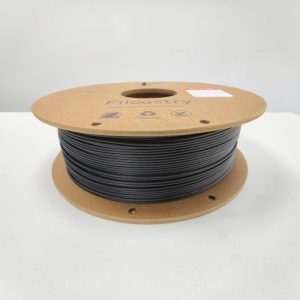 |
Enhanced Stiffness:Carbon fiber reinforcement generally increases material stiffness, helping printed components resist deformation under mechanical stress. For gear structures, this can help maintain tooth geometry under load.
Improved Dimensional Stability:Gear performance depends on accurate tooth geometry and appropriate engagement clearances. Carbon fiber reinforcement can help reduce material shrinkage and deformation, supporting dimensional consistency in functional printed parts. Lightweight Structural Design:PETG-CF offers opportunities to develop relatively lightweight structures with increased rigidity, making it worth exploring for mechanical assemblies, robotics, and industrial components. Matte Surface Finish:Unlike the relatively glossy appearance of standard PETG, PETG-CF typically produces a distinctive matte finish with a subtle textured appearance, giving printed parts a more technical, industrial look. |
Actual material performance depends on carbon fiber content, formulation, printing conditions, and component design.
Application Case: 3D Printed Gears Assembly
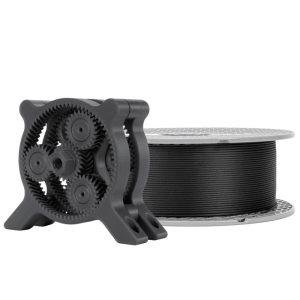
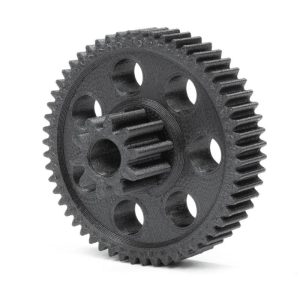
When manufacturing gears through FDM 3D printing, material selection is only one part of the process. Tooth geometry, printing orientation, layer adhesion, and assembly clearances all influence the final result.
Using PETG-CF for this assembly provides a practical opportunity to explore carbon fiber reinforced filament in mechanical applications.
This printed example demonstrates the manufacturability of the gear structure. However, load capacity, wear resistance, and long-term transmission performance require additional mechanical testing.
PETG-CF vs. Standard PETG: Key Differences
Although both materials share the same base polymer, carbon fiber reinforcement changes several important characteristics.
| Property | PETG-CF | Standard PETG |
|---|---|---|
| Stiffness | Generally higher | Moderate |
| Dimensional Stability | Potentially improved | Good |
| Surface Finish | Matte and textured | Printing Requirements |
| Nozzle Wear | Higher | Relatively low |
| Printing Requirements | Requires a wear-resistant nozzle | Relatively straightforward |
Standard PETG is suitable for general-purpose printing where toughness and ease of processing are priorities.
PETG-CF is a more suitable candidate when increased stiffness, dimensional consistency, and a matte industrial finish are desired. The final material choice should always depend on the component’s mechanical requirements.
Printing Considerations for PETG-CF
To achieve consistent results when printing with carbon fiber reinforced PETG, several factors should be considered.
Nozzle Selection: Carbon fibers are abrasive. A hardened steel or other wear-resistant nozzle is recommended to reduce nozzle wear and maintain consistent extrusion.
Filament Drying: Moisture can affect extrusion stability, surface quality, and layer adhesion. Dry PETG-CF according to the manufacturer’s recommended conditions before printing.
Printing Orientation: FDM components have anisotropic mechanical properties. For gears, printing orientation should account for tooth-root strength, load direction, and interlayer bonding.
Gear Clearances: Appropriate tolerances are essential for smooth gear engagement. Extrusion width, layer height, dimensional accuracy, and assembly clearance should be considered during model preparation.
For functional gear applications, additional testing under representative operating conditions is necessary to evaluate deformation, friction, wear, and fatigue performance.
The PETG-CF 3d printed gears assembly demonstrates how carbon fiber reinforced filament can be explored beyond conventional visual prototyping.
With its increased stiffness, potential for improved dimensional stability, and distinctive matte finish, PETG-CF offers an interesting material option for functional mechanical printing.
As FDM technology continues to expand into engineering and industrial applications, the combination of material selection, structural design, and printing quality will become increasingly important.