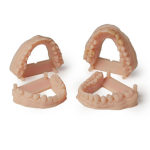
With advancements in technology, digital dentistry is rapidly emerging. Driven by the advent of 3D printing, the digital dental industry is revolutionizing the way traditional dental products are upgraded and new ones developed. Dental products require a high degree of customization; as a novel digital manufacturing technology, 3D printing enables the delivery of more precise and efficient treatment plans tailored to individual patient needs. Consequently, 3D printing technology holds immense promise for the future of dentistry.
Market research reports indicate that the global dental 3D printing market is valued at approximately $3.4 billion and is projected to reach roughly $3.9 billion by the end of 2026, representing a growth rate of about 17%. These figures demonstrate that the sector is experiencing rapid expansion. Thanks to their precision, accuracy, and efficiency, 3D-printed dental products are playing an increasingly vital role. An growing number of dentists are adopting 3D printing to fabricate restorations—such as dentures and bridges—and custom dental models, thereby driving the industry’s transition toward digital and personalized care.
Currently, three primary technologies dominate dental 3D printing applications: SLA, DLP, and LCD. Each offers distinct characteristics suited to specific use cases.
SLA technology entails the highest equipment and maintenance costs and requires a professional operating environment; however, its strength lies in the mass production of orthodontic models. It remains highly valuable for scenarios requiring stable, high-volume output of such models.
DLP technology offers high precision but is limited by smaller print dimensions, making it suitable primarily for small-scale restorative models like implant surgical guides. It is ideal for dental applications that demand high precision but involve smaller components, effectively meeting clinical requirements for detail.
LCD technology demonstrates strong all-around advantages. It features low equipment costs and supports both small- and large-format printing; combined with high precision and rapid forming speeds, it holds a distinct edge in small-batch production. For dental clinics, small processing centers, or scenarios requiring flexible production, LCD technology enables efficient customization at a lower cost.
In terms of application, 3D printing now spans multiple stages of dental care. In orthodontics, it is used to print orthodontic models; in implantology, to fabricate surgical guides; and in restorative dentistry, to customize prosthetics such as dentures and bridges, as well as dental models. By combining digital design with 3D printing, dentists can execute treatment plans more rapidly and accurately, thereby enhancing clinical efficiency and improving the patient experience.
Naturally, the development of dental 3D printing still faces challenges regarding material properties, equipment precision and stability, operational standards, and cost control. Overall, however, as digital intraoral scanning, CAD design, and 3D printing technologies mature, these three technologies will form a complementary ecosystem: SLA serves high-volume orthodontic model production; DLP focuses on high-precision, small-scale models; and LCD offers advantages in low-volume, multi-size, and cost-effective production.
It is foreseeable that 3D printing will unlock even greater potential within the dental field. It not only drives the upgrading of traditional dental products but also fosters the emergence of new product forms and service models. As the technology becomes more widely adopted, 3D printing will serve as a vital pillar of the digital dental industry, propelling dental care toward greater precision, efficiency, and personalization.