PETG-CF filament is a carbon fiber reinforced PETG material used in FDM 3D printing (PETG-CF printing). It combines a PETG polymer matrix with chopped carbon fibers to improve stiffness and dimensional stability while providing a distinctive matte surface finish.
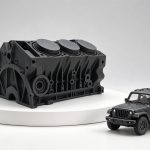
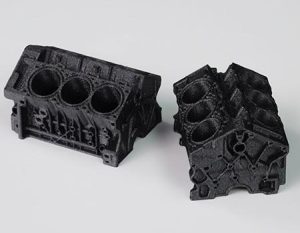
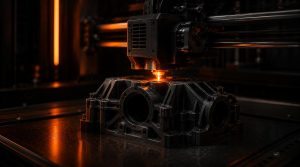
PETG-CF 3D Printing Automotive Model: In this project, we used PETG-CF filament to 3D print an automotive engine block model. The printed model reproduces key block features, including the crown, ring grooves, piston skirt, and pin openings. It demonstrates the potential of carbon fiber reinforced PETG for mechanical models, automotive prototypes, and engineering design applications.
What Is PETG-CF Filament?
PETG-CF is a carbon fiber reinforced thermoplastic filament made by incorporating chopped carbon fibers into a PETG base material.
Compared with standard PETG, PETG-CF generally offers higher stiffness and improved dimensional stability, depending on its formulation and fiber content. It also produces a characteristic matte finish that gives printed components a more technical appearance.
These characteristics make PETG-CF suitable for users who need rigid printed structures, defined geometries, and an industrial-style surface finish.
Why Use PETG-CF for an Engine Block Model?
|
PETG-CF combines a PETG-based material with carbon fiber reinforcement. Compared with standard PETG, carbon fiber reinforcement can contribute to increased stiffness and a distinctive surface appearance, depending on the material formulation. For this project, PETG-CF was selected for its suitability for producing a detailed mechanical model. Its characteristic matte finish also gives the printed engine block a more technical, industrial appearance. |
 |
Exploring the Structure of the 3-Cylinder Engine Block
The model brings together several recognizable engine features:
- Cylinder bores: Three aligned cylinder openings represent the main working spaces of an inline three-cylinder engine.
- Pistons: Three visible piston components sit within the cylinder openings, illustrating the arrangement of the engine’s reciprocating parts.
- Reinforcement ribs: The external ribs create a more realistic engine-block appearance while adding geometric complexity to the printed surface.
- Mounting and structural details: Openings, circular features, and connection points reproduce the visual characteristics of a mechanical engine housing.
These features make the model a useful example for observing how PETG-CF filament handles detailed shapes and complex geometries.
What Are the Applications of PETG-CF 3D Printing?
PETG-CF filament can be used in a range of applications where stiffness, dimensional stability, and surface appearance are important.
| Application | Typical 3D Printed Products |
|---|---|
| Automotive Prototyping | Engine models, component prototypes, design samples |
| Mechanical Engineering | Gears, brackets, housings, structural models |
| Industrial Applications | Mounting fixtures, equipment covers, functional prototypes |
| Product Development | Product enclosures, concept models, design verification samples |
| Educational Models | Mechanical assemblies, engine demonstration models |
The automotive piston is an example of how PETG-CF can be applied to engineering visualization and prototype development.
It is important to distinguish printed models from functional automotive components. This piston is an engineering visualization model, not a replacement for a real engine piston, which must withstand extreme temperatures, pressures, and friction.
PETG-CF 3D Printing Details and Surface Appearance
The engine block model contains a combination of large structural surfaces, narrow ribs, circular openings, and smaller geometric details. Printing these features requires attention to layer adhesion, dimensional accuracy, cooling, and support placement.
PETG-CF produces a distinctive composite-material appearance, with a textured matte surface that works well for mechanical models and engineering displays.
For consistent results, printing parameters should be adjusted according to the filament’s technical data and the geometry of the model.
How to Print PETG-CF Filament Successfully?
Proper material preparation and printer configuration are essential for achieving consistent PETG-CF printing results.
- Filament Drying: Dry PETG-CF before printing according to the manufacturer’s recommendations to reduce moisture-related defects.
- Nozzle Selection: Use a hardened steel or other suitable wear-resistant nozzle because carbon fibers are abrasive.
- Temperature Settings: Follow the filament manufacturer’s recommended printing temperature and adjust according to the printer.
- Printing Speed: Optimize speed and cooling to balance surface quality and layer adhesion.
- Print Orientation: Select an appropriate orientation to reduce unnecessary supports and preserve mechanical details.
These settings may vary depending on the printer, nozzle, filament formulation, and model geometry.
PETG-CF 3D Printing Filament for Mechanical and Engineering Models
This inline 3-cylinder engine block is a demonstration model rather than a functional automotive engine component. It illustrates how PETG-CF filament can be used to produce detailed mechanical prototypes, educational models, and engineering visualizations.
For 3D printing material manufacturers, projects like this also provide a practical way to demonstrate material appearance, print quality, and the ability to reproduce complex geometries.
PETG-CF filament offers an interesting material option for detailed mechanical models where structural appearance, surface finish, and print consistency are important.