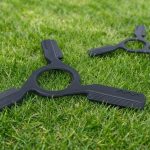
3D printing filament is expanding the possibilities of functional product development, including outdoor recreational equipment. This three-arm outdoor throwing game component is one example of how engineered 3D printing materials can be used to create practical products beyond decorative models.
As a 3D printing filament manufacturer, we explore how material selection, printing performance, and production consistency influence the development of functional outdoor products. With suitable filament properties and optimized printing conditions, FDM/FFF 3D printing can support the transition from product prototyping to repeatable batch manufacturing.
A Practical Outdoor Application of 3D Printing Filament
The three-arm throwing game component features a symmetrical design, a central circular opening, and textured surfaces along its arms. Its geometry illustrates the design flexibility of FDM/FFF 3D printing, which allows functional shapes to be produced without conventional tooling.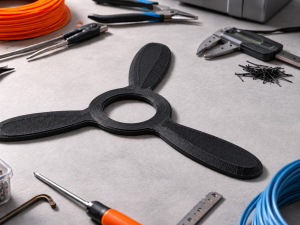
Unlike decorative models, outdoor game components must be designed for actual use. Handling, repeated throwing, potential impacts, and exposure to changing weather conditions all influence material and structural requirements.
This makes filament selection an important part of product development, rather than simply a decision about color or appearance.
What Material Properties Are Important for Outdoor Use?
Outdoor 3D printed products may encounter mechanical stress and changing environmental conditions. Their material requirements depend on how the finished part will be used.
| Material Property | Why It Matters |
|---|---|
| Impact Resistance | Helps withstand impacts during normal use |
| Toughness | Reduces the risk of cracking under mechanical stress |
| Dimensional Stability | Helps maintain the intended shape and dimensions |
| UV Resistance | Matters when products are exposed to prolonged sunlight |
| Moisture Resistance | Relevant to use in damp or wet environments |
These properties should be evaluated together with part geometry, wall thickness, infill, printing orientation, and operating conditions. A filament’s performance alone does not determine the durability of the finished component.
Choosing Engineered Filament for Functional Products
Carbon fiber reinforced filaments, such as PLA-CF and PETG-CF, provide additional material options for functional FDM/FFF applications.
Their characteristics differ depending on the base polymer and formulation:
- PLA-CF: Carbon fiber reinforcement can increase stiffness and create a distinctive matte surface finish. It may suit parts where rigidity and dimensional control are important.
- PETG-CF: Combines a PETG-based matrix with carbon fiber reinforcement, offering a balance of material characteristics for functional printed components.
Neither material is automatically suitable for every outdoor application. UV exposure, impact requirements, temperature variations, and moisture conditions should be considered before selecting a filament. Application-specific testing is necessary to verify performance.
From Prototyping to Repeatable 3D Printing Production
FDM/FFF printing allows product developers to modify dimensions and structural details without immediately investing in injection molding tools. This flexibility is useful when developing customized recreational products or refining a design before larger-scale production.
However, repeatable output depends on more than the printer itself. Important process factors include:
- Consistent filament diameter and material properties.
- Stable extrusion and feeding behavior.
- Suitable nozzle specifications and printing parameters.
- Appropriate wall thickness, infill, and print orientation.
- Consistent part dimensions and performance across batches.
For filament manufacturers, maintaining stable material quality helps customers establish reliable printing processes and achieve more predictable production results.
Other Outdoor Applications for 3D Printing Filament
Beyond recreational throwing games, engineered thermoplastic filaments can be explored for a range of outdoor products, depending on their performance requirements.
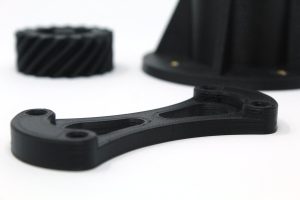 Potential applications include:
- Recreational game components.
- Garden and leisure accessories.
- Protective equipment housings.
- Customized outdoor fittings.
- Application-specific plastic components.
Each product presents different requirements for stiffness, toughness, impact resistance, and environmental durability. Selecting a suitable filament starts with understanding the conditions the finished part will encounter.
Conclusion
The three-arm outdoor throwing game component illustrates how 3D printing filament can be used in functional recreational product development.
For manufacturers and product developers, successful applications depend on matching material properties with product requirements, optimizing printing conditions, and maintaining consistent material quality. These factors help make FDM/FFF printing a practical option for both customized designs and repeatable production.
As a 3D printing filament manufacturer, we focus on developing material solutions that support reliable printing and help customers explore new functional applications.