Why Are Composite Filaments Gaining Attention in Industrial 3D Printing?
Industrial manufacturing increasingly requires customized components that are lightweight, dimensionally consistent, and suitable for specific equipment configurations.
While metal and conventional plastics remain widely used, they may not always be the most practical options for customized hardware, equipment modifications, or low-volume production.
PETG-CF (Carbon Fiber Reinforced PETG) offers an alternative for these applications. By combining a PETG polymer base with carbon fiber reinforcement, this composite filament provides increased stiffness and a distinctive matte finish, making it suitable for exploring various functional 3D printed components.
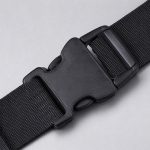
One potential application is industrial connecting hardware, including mounting brackets, connector adapters, and equipment support components.
What Makes PETG-CF Suitable for Functional Components?
Carbon fiber reinforcement changes the mechanical and visual characteristics of standard PETG, making PETG-CF an interesting option for functional 3D printing.
| Material Characteristic | Benefit for Functional Parts |
|---|---|
| Increased Stiffness | Helps components maintain their shape under appropriate loads |
| Dimensional Stability | Supports the production of accurately fitted parts |
| Matte Composite Finish | Provides a professional industrial appearance |
| Lightweight Construction | Offers an alternative to selected metal auxiliary components |
These characteristics make PETG-CF particularly worth considering when a project requires rigid, lightweight, and customized plastic hardware.
What Industrial Components Can Be Made with PETG-CF?
Beyond basic connectors, PETG-CF can be used to produce different customized hardware components through FDM 3D printing.
Two practical examples include:
Mounting Brackets and Connector Adapters
These components help connect, position, and secure equipment parts. Customized geometries can accommodate different mounting points, connection interfaces, and equipment layouts.
Equipment Fixtures and Protective Housings
PETG-CF can also be explored for positioning fixtures, equipment covers, and auxiliary protective structures where stiffness and lightweight construction are useful.
Why Choose PETG-CF for Industrial Connecting Components?
Industrial connectors need to maintain their shape and fit correctly within an assembly. Material selection therefore plays an important role in their design.
PETG-CF offers several characteristics that can support these requirements.
Rather than repeating general material advantages, the following table explains how its properties relate to practical connector applications.
| Application Requirement | How PETG-CF Helps |
|---|---|
| Structural Rigidity | Increased stiffness supports relatively rigid connector designs |
| Accurate Fitting | Dimensional stability helps with mounting holes and connection interfaces |
| Weight Reduction | Lightweight plastic construction can reduce component weight |
| Customization | FDM printing enables complex geometries without dedicated tooling |
Another important consideration is production flexibility. Industrial equipment often requires non-standard components that are difficult to source in small quantities.
With 3D printing, customized connectors can be developed and modified without relying on complex manufacturing tooling. This is especially useful for prototyping, equipment upgrades, and small-batch production.
However, PETG-CF should not automatically replace metal components in high-load, high-temperature, or safety-critical assemblies. Actual suitability depends on the design, print orientation, loading conditions, and material specifications.
Industrial Applications of PETG-CF Components
PETG-CF has potential applications in industrial environments where customized plastic hardware and lightweight auxiliary components are required.
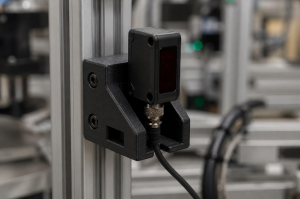 |
Machinery and Equipment Manufacturing PETG-CF can be considered for equipment mounting brackets, connector adapters, and auxiliary support structures. Its stiffness is useful for parts that need to maintain a defined shape within customized machine assemblies. |
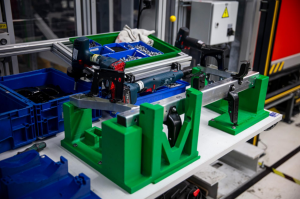 |
Industrial Automation and Assembly Automated production lines often require customized positioning fixtures and equipment accessories. PETG-CF offers a flexible option for producing these components in small quantities and adapting them to different assembly layouts. |
These applications are particularly relevant for non-critical hardware where customized geometry, lightweight construction, and production flexibility are important.
Printing Considerations for PETG-CF
To achieve reliable results, printing parameters should follow the filament manufacturer’s recommendations.
A few important considerations include:
-
Wear-resistant nozzle: Carbon fiber is abrasive, so hardened steel or another suitable wear-resistant nozzle is recommended.
-
Filament drying: Proper drying helps reduce moisture-related printing defects.
-
Layer orientation: Part orientation affects the mechanical performance of printed components.
-
Nozzle diameter: Select a suitable nozzle diameter according to the filament specifications and required detail.
For functional industrial parts, print quality and structural design are just as important as material selection.
Final Thoughts: Expanding Industrial 3D Printing Possibilities
PETG-CF offers an additional material option for producing customized industrial hardware. Its combination of increased stiffness, dimensional stability, lightweight construction, and composite surface finish makes it worth considering for mounting brackets, connector adapters, equipment fixtures, and auxiliary components.
For machinery manufacturing and industrial automation, it provides an opportunity to develop customized plastic parts with greater design flexibility.
The most important factor is selecting the right material and print configuration according to the actual mechanical and environmental requirements of each application.